
174
Modern industrial production operates under relentless pressure. Global supply chains face shifting trade dynamics, raw material price fluctuations, and persistent shortages of skilled labor. Meanwhile, end customers demand shorter lead times, customized product variations, and zero-defect quality. Meeting these expectations with traditional manual labor workflows is increasingly difficult.
Industrial robotics has moved from a speculative capital expenditure to an operational necessity. Rather than merely replacing repetitive manual tasks, modern automated machinery represents an intelligent, flexible infrastructure that drives production throughput. Advances in sensor precision, edge computing, artificial intelligence, and human-robot collaboration enable industrial operations to achieve levels of uptime, precision, and efficiency that were once impossible.
The Evolution of Industrial Robotics
Industrial robots were historically massive, hydraulically powered machines bolted to factory floors. Confined inside heavy steel cages to protect human operators, they performed static, high-volume motions like spot welding automotive frames or moving heavy foundry castings. While effective for repetitive mass production, their high initial costs, complicated programming requirements, and rigid workflows made them unsuitable for dynamic operations.
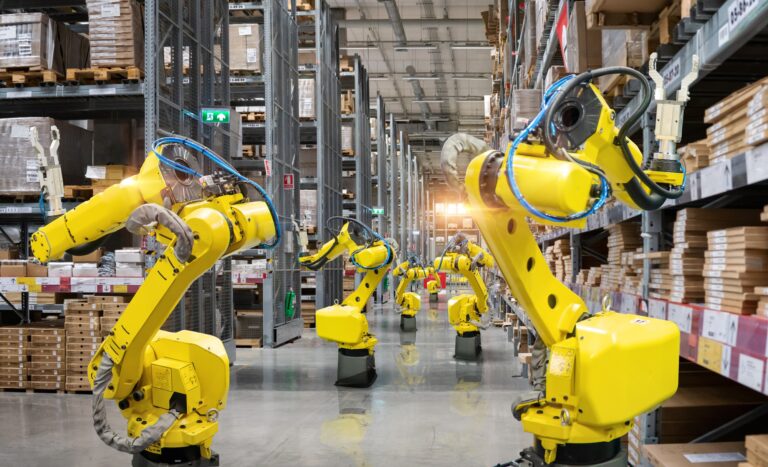
Today, industrial robotics features diverse form factors, modular designs, and sophisticated control systems. Modern facilities deploy a wide spectrum of specialized machinery:
-
Articulated Robotic Arms: Multi-axis units capable of complex spatial movements, widely used in precision assembly, welding, painting, and high-speed pick-and-place operations.
-
SCARA and Delta Robots: Selective Compliance Articulated Robot Arms (SCARA) and overhead delta robots engineered for ultra-fast, highly repeatable sorting, packaging, and micro-component handling.
-
Collaborative Robots (Cobots): Lightweight, sensor-rich machines equipped with force-torque feedback that work safely alongside human operators without safety fencing.
-
Autonomous Mobile Robots (AMRs): Self-navigating mobile units that transport inventory, raw materials, and finished goods across busy shop floors using real-time spatial mapping.
This technological evolution shifts robotics from isolated production islands into an interconnected ecosystem that enhances productivity across all manufacturing stages.
Boosting Throughput and Continuous Production
Human endurance has physiological limits. Physical fatigue, shift transitions, lunch breaks, and repetitive motion injuries naturally create bottlenecks along manual production lines. Machine systems, conversely, are engineered for continuous mechanical performance.
Robots run at controlled, optimized speeds around the clock. By eliminating shift changeover lag and sustaining continuous production schedules, facilities scale output without expanding physical plant footprints. In high-precision operations such as surface-mount electronics assembly or injection molding, robots handle intricate assemblies at speeds human hands cannot match.
Furthermore, automated workflows stabilize line balancing. In traditional assembly, speed variations among workers cause upstream pileups and starve downstream stations of parts. Robots follow precise, programmable cycle times. This predictability allows plant managers to schedule production runs down to the second, matching raw material deliveries directly with assembly rates.
Precision, Quality Assurance, and Waste Reduction
Speed without accuracy only produces scrap faster. The true productivity advantage of robotics lies in combining rapid mechanical execution with micrometer-level repeatability.
Manual tasks like arc welding, adhesive dispensing, and precision machining are vulnerable to human fatigue. Inconsistent seam tracking, uneven glue thickness, or slight machining deviations lead to defective parts that require manual rework or complete disposal. Advanced industrial robots deliver repeatable positional tolerances under 0.1 millimeters. This consistency ensures the ten-thousandth production cycle matches the first with identical structural integrity.
Integrated machine vision elevates quality control even further:
-
Real-Time Visual Inspection: High-resolution cameras and 3D laser profiling systems scan parts on the fly, catching surface flaws, dimensional variances, or missing fasteners before workpieces reach downstream stations.
-
Dynamic Part Location: Machine vision enables robotic grippers to detect, orient, and manipulate randomly placed workpieces moving down conveyor belts, eliminating expensive custom tooling and mechanical sorting jigs.
-
First-Pass Yield Optimization: Consistent application of torque, heat, and pressure drives up first-pass yield metrics, reducing scrap costs and saving expensive raw materials.
Reducing scrap and rework frees up inspection personnel and production capacity, directly raising overall factory productivity.
Enhancing Workplace Safety and Workforce Leverage
Worker safety directly affects industrial productivity. Workplace injuries halt production runs, trigger costly regulatory audits, drive up insurance premiums, and leave companies understaffed. Heavy industries feature hazardous environments involving extreme heat, toxic fumes, high-voltage equipment, and sharp sheet metals.
Deploying robots to handle hazardous duties isolates human employees from physical risks. Automated arms handle hot foundry operations, spray-apply volatile chemical coatings in sealed ventilation booths, and lift heavy metal billets into stamping presses.
Robotic automation also mitigates chronic ergonomic strain. Repetitive lifting, continuous wrist rotation, and prolonged overhead reaching cause musculoskeletal disorders, which account for extensive worker sick leave. Automating these repetitive mechanical duties protects worker health.
Far from simply eliminating manufacturing jobs, robotics changes how workers are deployed. Employees transition from performing repetitive physical labor to higher-value roles:
-
Supervising automated work cells and loading material magazines.
-
Programming robotic trajectories and teaching novel parts routines.
-
Conducting preventive maintenance and tuning diagnostic sensors.
-
Analyzing production bottleneck data to run continuous improvement initiatives.
Upskilling frontline personnel improves morale, reduces turnover, and directs human cognitive abilities where they add the most value: operational problem-solving and process innovation.
The Flexibility of Collaborative Robots and Rapid Changeover
The modern consumer marketplace has largely moved away from multi-year runs of standardized products. Today, manufacturers must accommodate high-mix, low-volume (HMLV) production orders, frequent packaging revisions, and seasonal runs. Traditional automated lines took weeks or months to mechanically retool, making automation impractical for smaller operations.
Collaborative robots address this operational challenge. Cobots feature intuitive programming interfaces that allow line technicians to train movements via lead-through teaching. A technician can guide the robot arm through a trajectory by hand, confirm the waypoints on a tablet interface, and have a new packaging or screwdriving routine running in minutes.
The lightweight frames and standard power requirements of cobots allow them to be moved between workstations as production demands shift:
-
Supporting machine tending on computer numerical control (CNC) mills in the morning.
-
Moving to a packaging and palletizing station in the afternoon to box finished goods.
-
Operating in shared manual assembly cells alongside human workers without cumbersome safety enclosures.
This agility allows small and medium-sized manufacturers to automate dynamic, short-run jobs cost-effectively, leveling the playing field against larger enterprises.
Smarter Workflows Through AI and Edge Connectivity
The modern robotics wave is distinguished by its convergence with artificial intelligence, edge computing, and the Industrial Internet of Things (IIoT). Modern robots are not isolated mechanical devices following blind scripts; they are connected data terminals that sense and adapt to their environments.
Embedded edge computing chips allow robotic controllers to run real-time machine learning models. If incoming casting dimensions vary slightly, an AI-guided robot automatically adjusts its toolpath to account for the difference. Force-torque sensors measure mechanical resistance in real time, letting polishing robots adjust surface pressure dynamically across complex curved surfaces.
Connected robotics also support advanced predictive maintenance strategies:
-
Real-time monitoring of motor current draw, gearbox temperatures, and joint vibrations identifies mechanical wear weeks before a physical breakdown occurs.
-
Maintenance crews can swap out degraded bearings or servomotors during planned weekend changeovers, completely avoiding unexpected production shutdowns.
-
Machine diagnostic telemetry feeds enterprise resource planning (ERP) platforms directly, updating inventory levels and tracking overall equipment effectiveness (OEE) across the factory.
By combining physical automation with real-time data processing, industrial facilities transform into connected, responsive production engines that adapt swiftly to market demands.
Frequently Asked Questions
What is the difference between an industrial robot and an automated guided vehicle?
An industrial robot is primarily a manipulative mechanical device, such as a multi-axis articulated arm, designed to handle tools, weld metals, assemble components, or lift items within a fixed workstation. An automated guided vehicle (AGV) or autonomous mobile robot (AMR) is a mobile transportation platform designed to move inventory, raw components, and finished pallets across a facility floor using floor markers, optical lines, or lidar-based spatial mapping.
How do collaborative robots guarantee safety when operating near human workers without cages?
Collaborative robots employ redundant safety mechanisms built directly into their structural design. They use low-inertia servomotors, rounded frames without pinch points, and internal force-torque sensors in every joint. If a cobot arm contacts an unexpected object or person, the system detects the resistance within milliseconds and stops motion immediately, preventing injury. Many cobots also use integrated optical area scanners that slow down machine speed as a human approaches and halt completely if the person enters the primary operating zone.
What is the average payback period for industrial robotics investments?
While investment costs vary based on tooling, software integration, and application complexity, most manufacturing facilities achieve a full return on investment within twelve to twenty-four months. Financial payback is accelerated through savings across labor expenses, reduced scrap, lower worker compensation claims, higher product consistency, and gains in total weekly throughput.
Can industrial robots be effectively integrated into older facilities with legacy machinery?
Yes. Modern robots communicate through universal industrial communication protocols and can interface with older equipment using modular input-output (I/O) modules. For instance, a robotic arm can easily tend a twenty-year-old manual stamping press by monitoring electrical limit switches or pneumatic relay signals, modernizing legacy machinery without requiring costly machine replacements.
What programming skills are needed to operate modern industrial robotics?
While complex multi-robot automotive welding cells still require specialized automation engineers familiar with structured industrial code, modern standalone cobots and light articulated arms do not require advanced programming degrees. Many newer units feature visual block-programming interfaces, drag-and-drop tablet software, and manual lead-through teaching. This allows standard shop-floor technicians to learn basic path programming and operational adjustments within a few days of training.
How do environmental factors like dust, heat, and moisture affect robot performance?
Industrial robots are engineered with distinct Ingress Protection (IP) ratings tailored to specific operating environments. Standard factory robots typically feature IP54 protection against light dust, while units built for harsh environments, such as foundry casting, waterjet cutting, or food-grade washdown rooms, feature IP67 or IP69K sealed housings. These specialized models use chemical-resistant coatings, stainless steel fasteners, and pressurized internal air seals to prevent moisture, abrasive dust, and sanitizing chemicals from damaging internal electronics and bearings.
Which industrial sector currently leads in the deployment of robotics?
The automotive and electronics manufacturing sectors have historically led global adoption, utilizing large fleets of robots for body welding, painting, component placement, and battery pack assembly. However, rapid adoption is expanding into logistics, food and beverage processing, pharmaceuticals, plastics molding, and metal fabrication, driven by versatile collaborative robots and intuitive machine vision systems.
